
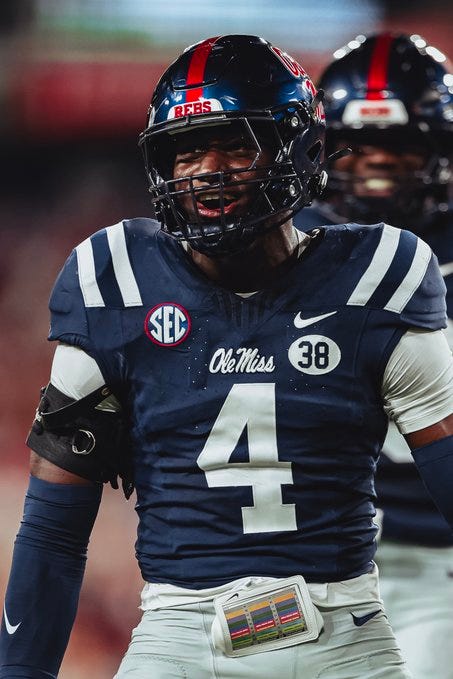
Ole Miss survived Louisville. That’s probably the most apt description for what unfolded in Nashville on Sunday night. The Rebels needed a walk-off field goal from Lucas Carneiro to seal the win, but nevertheless, Ole Miss is 1-0, beat a ranked team, and now moves closer to a daunting nine-game SEC schedule.
There was some good, some not so good and some outright bad in this season-opener. I can’t really think of a better way to dissect everything that happened than separating the good and bad aspects of the game, so let’s take a look at both in alternating order.
The good: Ole Miss won the football game
This is the type of white-hot analysis that leaves you constantly craving to read this newsletter. Yes, it’s good that Ole Miss won the game. As simple as that sounds, it’s important to note simply from this standpoint: Ole Miss’ expectations would’ve been all but dashed in the season’s first week had the Rebels lost this football game. I’ll spend some time later in this column talking about how, every single year, people overreact to week one games, and I might sound hypocritical saying that after leading with the idea that Ole Miss’ season was dead had it lost last night, but it’s the truth.
With the SEC going to a nine-game conference schedule, and the Rebels’ slate being incredibly more difficult than last season’s, there was no realistic path for this team to make the Playoff with a loss to Louisville. Had Ole Miss lost to the Cardinals, the Rebels would have essentially needed to go 10-1 in their final 11 games, which include road trips to Texas, Oklahoma, and Florida, with home games against Georgia and LSU — not to mention that Missouri and Mississippi State (both home games) will almost certainly be more competitive than each were a season ago.
Pete Golding and Ole Miss entered this season with expectations of making the College Football Playoff, or at the very least, being in the mix in November. Whether you think that’s fair or unfair, it’s reality. Ole Miss returns the best offensive backfield in the sport and spent money to build an expensive roster capable of competing for the SEC Championship and the National Championship. The entire offseason discussion about this team’s goals and expectations would’ve been rendered moot with a loss.
Ole Miss survived and breathed a collective exhale when Carniero’s field goal sailed through the uprights. The Rebels are 1-0 and onto the next challenge.

The Cowboy Country Club is a brand that was founded on the basis of building a community that you can not only feel proud to be a part of, but also one that you can make yours. Go to CowboyCountryClub.com and go buy the best merch on the market. Use the promo code “HottyToddy20” for a discount just for being a subscriber to Rippee Writes.
The Bad: both sides of the ball played a dud half
Calling a football game a “tale of two halves” is among the most cliché and unoriginal ways a sportswriter can describe a game, but in this case, it’s pretty apt.
The Ole Miss offense was bad in the first half while the defense, for the most part, was pretty good. The Rebels’ offense in the second half was explosive while the defense was horrendous. It all somehow equated to a three-point win against a team that I think will end up being pretty good this year. I think Louisville will be firmly in the mix to win the ACC late into November. The Cardinals have a good defense, two of the best running backs in their league and a talented but unproven quarterback who played exactly like you’d expect a highly-rated recruit who has taken very few live snaps the last three seasons would play.
The Ole Miss offense looked very clunky in the first half of new offensive coordinator John David Baker’s power four debut. In fairness, it was pretty difficult to judge the competence of Baker’s system considering the fact that Ole Miss turned the football over on two of its first five possessions — and really, in terms of killing a drive, three of its first five, because Brycen Sanders’ errant snap on the second play of the game nuked the Rebels’ opening drive.
The defense picked up the offense’s slack in the first thirty minutes, at one point stopping Louisville on three straight drives to the tune of the Cardinals netting -26 yards on those three drives.
But as the offense found its footing, scoring touchdowns on four of its six second-half possessions, the defense faltered, mostly due to poor tackling and communications issues that primarily manifested in the secondary in the form of three or four pretty horrific coverage busts that gifted Louisville a couple of touchdowns.
The good news is that the issues on both sides of the football are fixable and aren’t due to a lack of talent or depth. The bad news is that if these issues are repeated again (beginning in two weeks against LSU), Ole Miss will get run off the field by pretty much every opponent on its schedule not named Charlotte or Citadel.
For Ole Miss, all of this can be rectified, but it can ill-afford to repeat a performance like this.
The Good: Chambliss looked like a bonafide superstar
Ole Miss won on Sunday evening because it had the best football player on the field. Trinidad Chambliss, after a shaky, turnover-riddled first half from the offense, was tremendous in the second half. Chambliss finished the game 21-36 for 336 yards with three touchdowns and one interception. He threw a pair of 62-yard touchdown passes to his only returning receiver in Deuce Alexander, the first of which was an elite-level throw in which he threw the football before Alexander was open, commonly referred to as “throwing a guy open”.

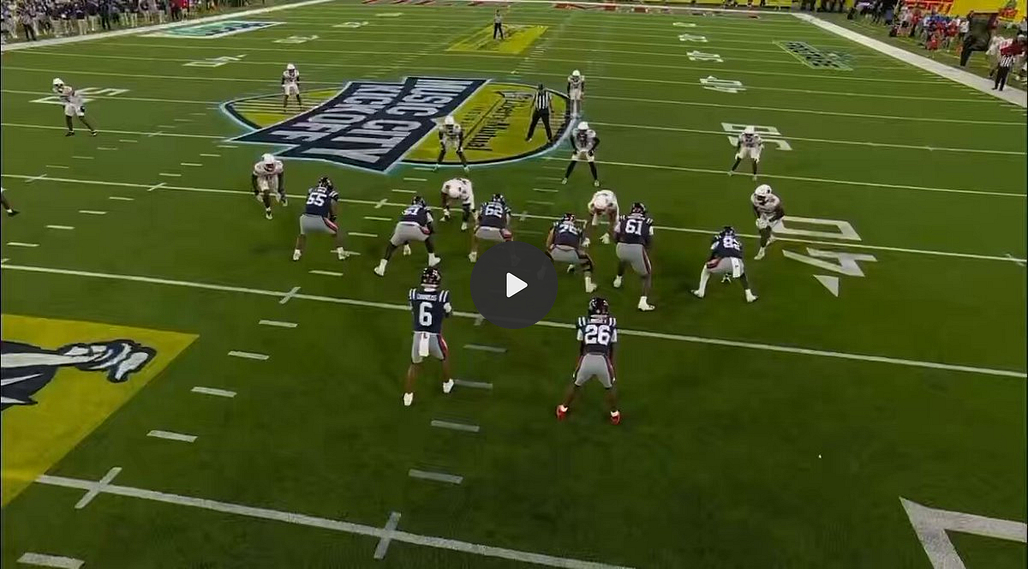

It was elite-level stuff.
Ole Miss led 38-24 with less than six minutes remaining in the game. It should never have had to muster a game-winning drive to put this one away, but it did. And there wasn’t anyone on earth more confident that the Rebels would win the game than Chambliss, who begrudgingly, has a knack for playing his best when the margins are the thinnest.
“I honestly hate games like this. I don’t know why we keep doing this,” Chambliss quipped after the game.
I am a little surprised Louisville didn’t elect to go for two when it scored a game-tying touchdown with 1:28 remaining to bring the score 38-37. I suppose it wouldn’t have mattered in hindsight given the drive Chambliss and the Ole Miss offense orchestrated in the final 88 seconds of the game. What I do know is that I wouldn’t have loved Ole Miss’ chances in overtime with the way that game was trending. In hot, muggy conditions, the Rebels had players dropping like flies on both sides of the football. Louisville certainly had all of the momentum, if you believe in such a thing, after it scored to tie the game. Chambliss led a drive to thwart that momentum and render all other hypotheticals moot because he was the best player on the field and is arguably the best quarterback in college football.

A-Stock’s mission is to provide our customers with the power to name their price. Our inventory changes weekly, allowing you to browse products for all occasions. We’ll let you in on our little secret: We buy in bulk from major retailers, which helps us, help you name your price. These items tend to be overstocked, returned, or closeout products. With convenient locations in Tupelo, Memphis, Nashville, East TN, & KY, you can buy from A-Stock in two ways:
1. At one of our many bin stores
2 at AStock.com / A-Stock Bids App. All items online start at just $1. Explore our inventory of items grouped by location and sale events. Each sale has a specific end date and time, so you know exactly when bidding closes. Place your bids on items you want. No shipping or transfers available, all items must be picked up at the specified location.
The bad: two first half turnovers
Like I mentioned earlier, it was really three turnovers because the Sanders bad snap on the game’s second play killed Ole Miss’ first drive.
The best word I can come up with to describe how the offense looked in the first half is clunky. Everything looked difficult. Ole Miss wasn’t explosive at all in the running game, it wasn’t really able to push the football down the field through the air, and a Chambliss fumble and interception derailed any chance the Rebels had of finding cohesiveness in the first half.
John David Baker is going to face a lot of scrutiny this season, some fair and some unfair. It comes with the job he accepted — replacing two of the best offensive minds in the sport in Lane Kiffin and Charlie Weis’ Jr.
Baker of course worked under Kiffin for three seasons at Ole Miss and worked under Weis for two. It’s a core reason why Golding hired Baker — for continuity’s sake. That’s not to say Baker isn’t qualified. He left Ole Miss to become the offensive coordinator at East Carolina in 2024. The Pirates were 130th out of 133 FBS teams in total offense before Baker took over. They were 24th in 2024 and 19th in 2025. He produced incredible results in the two seasons he was in charge at East Carolina. We heard for most of the offseason that this offense was “80 percent the same with some different terminology.” It didn’t really look close to the same for the first two quarters of this game — and I am not saying that just because it looked bad.
If you’ve read this newsletter long enough, you know that I happily admit I am a fairly untrained eye when it comes to the schematics of football. I am not going to bullshit any of you out there by trying to explain things I don’t understand in terms of play-calling and offensive scheme. You can go read that type of (mostly) uninformed slop a million other places.
Instead, I’ll give you my real-time thoughts watching this game: I thought the Ole Miss offense looked conservative and disjointed in the first half. The Rebels barely threw the football down the field and kind of tried to force-feed Kewan Lacy the football with pretty average results. I figure some of that is probably due to the way the Louisville defense was playing the Rebels. What I mean by that is that Louisville was not aggressive at all defensively in this game. The Cardinals had one tackle for loss in the game. It seemed like they wanted to protect against long, explosive plays and make Ole Miss put together double-digit play drives by keeping everything in front of them. I think that’s why you saw Chambliss opting for check down throws at or near the line of scrimmage a lot throughout the first half.
Louisville invited the Ole Miss offense to either get impatient or shoot itself in the foot first half, and the Rebels happily obliged with the latter.
The good: 340 second-half yards with four touchdowns
I covered some of this earlier, but the offense was much better in the second half, which is particularly impressive considering it played the second half without Lacy, who was sidelined with a bone bruise (more on that in a bit).
MPW Postgame show participant Jeffrey Wright posed an interesting theory on Sunday’s postgame show. He essentially wondered if Lacy exiting the game with an injury forced Ole Miss to lean on Chambliss and push the football down the field through the air. It’s an interesting thought considering 261 of Chambliss’ 336 yards through the air came in the second half. As the Rebels offense became “more vertical,” for the lack of a better phrase, in the second half, the offense was more explosive. Louisville was seemingly content with playing its base level Cover 3 pass defense against Ole Miss for most of the night and the Rebels burned them in the second half.
Ole Miss scored touchdowns on four of six drives in the second half. And really four of five considering the last drive intentionally ended with a field goal. That dog will hunt. The first half performance won’t cut it.
It’s game one with a lot of new on the offensive side of the ball. We’ll see how it progresses.

Watson Turnipseed is a proud Rippee Writes sponsor. Have you been injured in a car accident or at work? Have the insurance companies denied your claim? Get more than one call with Watson Turnipseed. Call 504-636-8217
The bad: second half defense
Ole Miss allowed 32 second-half points to a Louisville offense that looked pretty stagnant in the game’s first two quarters.
Louisville had nine plays of 25 yards or more. The Rebels allowed 386 yards to the Cardinals in the second half. It was a perplexing and frustrating performance for the Ole Miss defense, mainly because none of the issues seemed to stem from a lack of talent or manpower. Maybe I am wrong, but there wasn’t a moment during that game that I thought to myself “Oh, Ole Miss just can’t cover these receivers Louisville has. They’re too small and too slow.”
or
“Ole Miss can’t really do much about Cardinals running back Isaac Brown. The Rebels just don’t have the horses to put up a formidable run defense.”
The Rebels’ issues against the Cardinals were almost entirely due to terrible communication that led to at least three and (I think four) horrific coverage busts that gifted Louisville three touchdowns. Thankfully, because Louisville quarterback Lincoln Keinholz isn’t a consistently accurate thrower of the football, the most glaring bust didn’t lead to any points — the one in the second quarter when Ole Miss, let a slot receiver run free down the field for what would’ve been a touchdown that would’ve but Louisville up 10-3 had Keinholz not overthrown the receive who did not have a defender in the same zip code as him — I can only wonder how the game turns out if Louisville scores on that play.
There are two ways to look at the issues the Ole Miss defense faced in this game, which I think are two main categories: tackling and coverage busts.
The positive outlook is that coverage busts are pretty easily fixable through practice and film study. The tackling portion can be fixable, too. It was game one. These guys don’t do much tackling in preseason camp due to fear of injury. Sloppy tackling in a season opener is hardly an issue unique to this Ole Miss defense. Again, it’s not a talent problem, which is good.
The pessimistic lens to view it through is that if this is repeated, Ole Miss will be in a world of hurt. The margins are too thin in the Southeastern Conference to be a bad tackling team. Missed communication in coverage could mean guys are being asked to do too much and don’t understand the scheme. Golding had a really interesting quote about this in his postgame press conference.
“In these big games, you have to be very multiple to have a chance to win,” Golding said. “It’s very easy to go vanilla early on to let them have a crutch. I wasn’t going to do that because that is not who we are going to be, and that is not what it takes to win championships. There were some of those things from a coaching standpoint to clean up as far as who is in the game and have they shown us the ability to do that or not. But, to me, you aren’t going to know until you get into it… Getting a couple of guys banged up in the back end didn’t help. Sharief (Denson) didn’t play, who has started all of camp. (Antonio) Kite goes out of this game early. I should have done a better job in the second half, to be honest with you, to not put too much on them, which I probably did.”
Golding mentioned a few times during preseason camp that the secondary wasn’t completely healthy and that guys were having to rotate around — which I figure, in his mind, ideally, would create some positional versatility in the secondary during the season once everyone got healthy — and that he didn’t limit the proverbial play-calling menu on Sunday just because the Rebels were banged up and had guys playing positions without much experience.
I’m not saying he’s wrong in this thinking, and the Ole Miss defense, particularly the secondary, may end up better for it in the end. But what I do know is that the egregious coverage busts Ole Miss had in this game simply cannot be repeated in two weeks when LSU rolls into town, and if they are, the Rebels will get run off the field.
The good: the defensive line is fierce and deep
Before this game became a track meet and the Ole Miss defense let Louisville receivers run wild, I thought there were points in this game in which the Rebels defensive line really imposed its will against an unproven Louisville offensive line that boasted four new starters via the transfer portal (with the left tackle being the lone exception). Louisville had three consecutive first half drives that netted a combined -26 yards. Ole Miss had eight tackles for loss in this game and sacked a mobile and shifty Keinholz three times. Kam Franklin’s fourth-quarter sack on Keinholz deep in Cardinals territory that gave Ole Miss the football back up seven points should’ve been the beginning of the end of this game (even though it wasn’t). I thought this defensive line looked pretty dominant at times.
Golding mentioned throughout the offseason that he didn’t think Ole Miss had enough defensive line depth last season and that guys played too many snaps. Ole Miss rotated a lot of guys on the defensive line in this game and I think I feel confident in saying this staff has rectified the lack of depth issue. Almost all of them looked pretty good too. This staff took a flier on Jaheim Oatis — a highly-rated (Columbia) Mississippi kid out of high school who signed with Alabama (Golding beat Ole Miss for his services in his last year as defensive coordinator at Alabama) who flamed out in Tuscaloosa and at Colorado due to not being in shape — played a lot more than I thought he would and played well in this game. He’s got all the talent in the world, he just needs to harness it and remain in shape.
Anyway, point being, I thought this defensive line looked like the real deal for parts of this game. There was some pass rush and gap-integrity stuff with Keinholz that allowed him to scramble and extend plays with his feet throughout the game that was less than ideal, and there were a few possessions in which Louisville had some success running the football that was somewhat concerning. But overall, I liked what I saw from the defensive line and the depth it boasts.
The bad: offensive line injuries and depth
I thought the offensive line’s collective performance in this game was fine. Ole Miss wasn’t really explosive in the running game. But again, Lacy was out for essentially half the game, so I am not sure how to fairly grade that aspect of things. The pass protection was okay for the most part, I guess, but Chambliss also bails out this offensive line with how ridiculously quick he is exiting the pocket and turning a bad situation into a productive play. His first step to exit the pocket and either run or roll out to make an off-platform throw is truly remarkable.
My main concern with the offensive line is the injuries in the game. Right tackle Tommy Kinsler IV left the game in the second half — a position that was already a major question mark for this unit and this offense entering the season — and was replaced by Connor Howes. What is interesting to me about that is that the battle we heard about throughout preseason camp was between Kinsler (Miami transfer) and Carius Curne (LSU transfer) for the right tackle job. The consensus was that the staff likes Kinsler but didn’t think he was totally in shape (a sentiment echoed on the broadcast during the game: suboptimal) and also loved Curne’s ability but doubted his maturity. Curne was arrested in the offseason for possession of drug paraphernalia and evading arrest. Charges were later dropped.
Kinsler going down with an injury and the staff electing to play Howes over Curne is both telling and potentially concerning. The former is pretty obvious in how it is telling. This staff doesn’t trust Curne. It’s potentially concerning in the sense that Curne was obviously viewed as the most talented or second most talented guy to be the Rebels’ right tackle, but can’t be trusted to play. On the bright side, Howes apparently did pretty well in the 35 snaps he saw.

Left guard Delano Townsend was also injured in this game. It doesn’t sound like it is a severe injury, but this offensive line cannot withstand a rash of injuries. They were a thin unit a year ago that stayed pretty much entirely healthy, which is a significant reason why Ole Miss made and advanced in the College Football Playoff. This unit getting banged up will be a real problem for the Rebels. This is not an Ole Miss-centric issue, either. In this transfer-portal era, pretty much no one has good offensive line depth, which makes the health of this position group paramount for every team’s postseason hopes, Ole Miss included.
The good: some intriguing pass-catcher emerged
Once we got past the offensive slog that was the first half, I thought Ole Miss’ pass-catching corps fared pretty well. Caleb Odom had a nice game. He is a walking mismatch and a really interesting weapon for Ole Miss given his freakish body frame.
I also thought Auburn transfer Horatio Fields looked pretty good, too. He caught five balls for 47 yards. People at Auburn loved Fields. He was just mired in the dysfunction that was Hugh Freeze’s offense in the modern era.
Deuce Alexander certainly showed he can be a No. 1 option too. His breakaway speed is remarkable. After the game, Golding compared him to former Alabama receiver and current Detroit Lion Jameson Williams. That’s a pretty apt comparison and also high-praise from Golding.
The bad: injuries as a whole
One of the many things that made the whole vibe of this game weird was Ole Miss having guys injured, and not just guys, like key players, being helped off the field.
It was a ridiculously hot night in Nashville. Because the Tennessee Titans are an utterly incompetent franchise, they decided to replace their natural grass field with turf a couple of years ago — which only compounded the temperature issue at kickoff.
It seemed like some injuries were cramps, like Alexander leaving the game. Golding said Echoles got “stepped on” and that it wasn’t serious. I don’t know what happened to Townsend or Kinsler but Golding didn’t seem to think any of the injuries the Rebels suffered were that serious, which is good.
And of course Lacy left with a bone bruise. I imagine we won’t see him again until the LSU game in 12 days.
Having this many guys leave the game isn’t ideal, but none of it sounds catastrophic.
Final thoughts
That was as many good-and-bad comparisons as I could muster for a game that provided a lot of content.
Ole Miss is a good football team that beat a ranked team at a neutral site despite not playing very well. Were there some alarming things in this game? Yes, of course. Was it a perfect audition for Golding in the first game in which he’s coaching his own team and is fully in control of the program? No, not hardly.
For those of you chronically online, is the reaction to Ole Miss’ performance a bit over the top in terms of doubt and criticism? Yes, of course it is. And it’s obviously tied to how good LSU looked on Saturday night. It would be naive not to mention and admit that. But that’s the neighborhood Ole Miss lives in as it tries to remain a big-time college football program and prove it is and will remain a consistent contender in life after Lane Kiffin. This is the sandbox you play in now. It comes with increased scrutiny. None of it ultimately matters a ton. Weird things happen in week one of the college football season, and we all overreact every year when they happen.
Ole Miss has issues it needs to clean up, but everything wrong with the Rebels is fixable. They now have two weeks to fix it before the circus from Baton Rouge comes to town.